

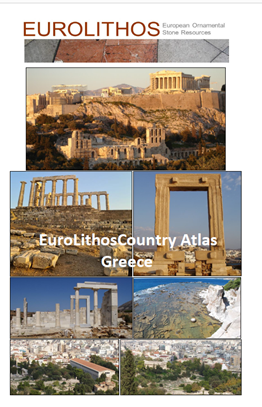
The pan-European program GeoERA, titled “Establishing the European Geological Surveys Research Area to create a Geological Service for Europe,” has been successfully completed.
GeoERA was initiated through EuroGeoSurveys — the organization of European Geological Surveys — as part of the vision to create a Geological Service for Europe. It involved all Geological Survey Organizations (GSOs) across Europe. The results of GeoERA can support, at the European level, policy planning and decision-making related to the accessibility, availability, and sustainable use of subsurface resources. These factors play a crucial role in addressing one of Europe’s major societal challenges: achieving economic growth and social welfare while maintaining a healthy and safe living environment for its citizens.
EAGME’s participation in EuroLithos
Among the subprojects in which EAGME participated was the European Ornamental Stone Resources (EuroLithos). Although decorative stones are an important raw material currently quarried throughout Europe, their use at local and regional levels is declining, along with the associated knowledge, traditions, and skills.
The EuroLithos program was based on the idea that increasing knowledge of the geology, quality, and history of the use of natural stones in Europe would promote the sustainable use of these materials to the benefit of SMEs and our cultural heritage, while also supporting sound land-use management to preserve deposits of natural stones.
EuroLithos led to the development of a knowledge base for ornamental stones under the umbrella of EGDI (https://www.europe-geology.eu/), providing harmonized spatial data for European ornamental stones and a catalog of their properties.
Within EuroLithos, EAGME and specifically the LITHOS Laboratory, led by K. Laskaridis — coordinator of the work package for designing the catalog of ornamental stone properties — collaborated with Angeliki Arapakou, Ch. Papatrechas, M. Patroni, and I. Kouseris. The main objective was to develop a distinct “identity” for each of Europe’s ornamental stones, based on their mineral composition, physical–mechanical and chemical properties, and in accordance with European Standards EN (EN 12440: Criteria for naming and EN 12670: Terminology) for both lithological classification and the cataloging of European natural stones.
The EuroLithos program was implemented by 16 partners from 14 countries, collectively forming a strong and innovative research team. To date, 1,220 unique types of ornamental stones have been recorded, with 350 of them including detailed descriptions — 66 of which are from Greece. The database will continue to expand even after the project’s completion, with new materials being added over time.
You can explore, for the first time, the European Atlas of Ornamental Stones at the link below: