
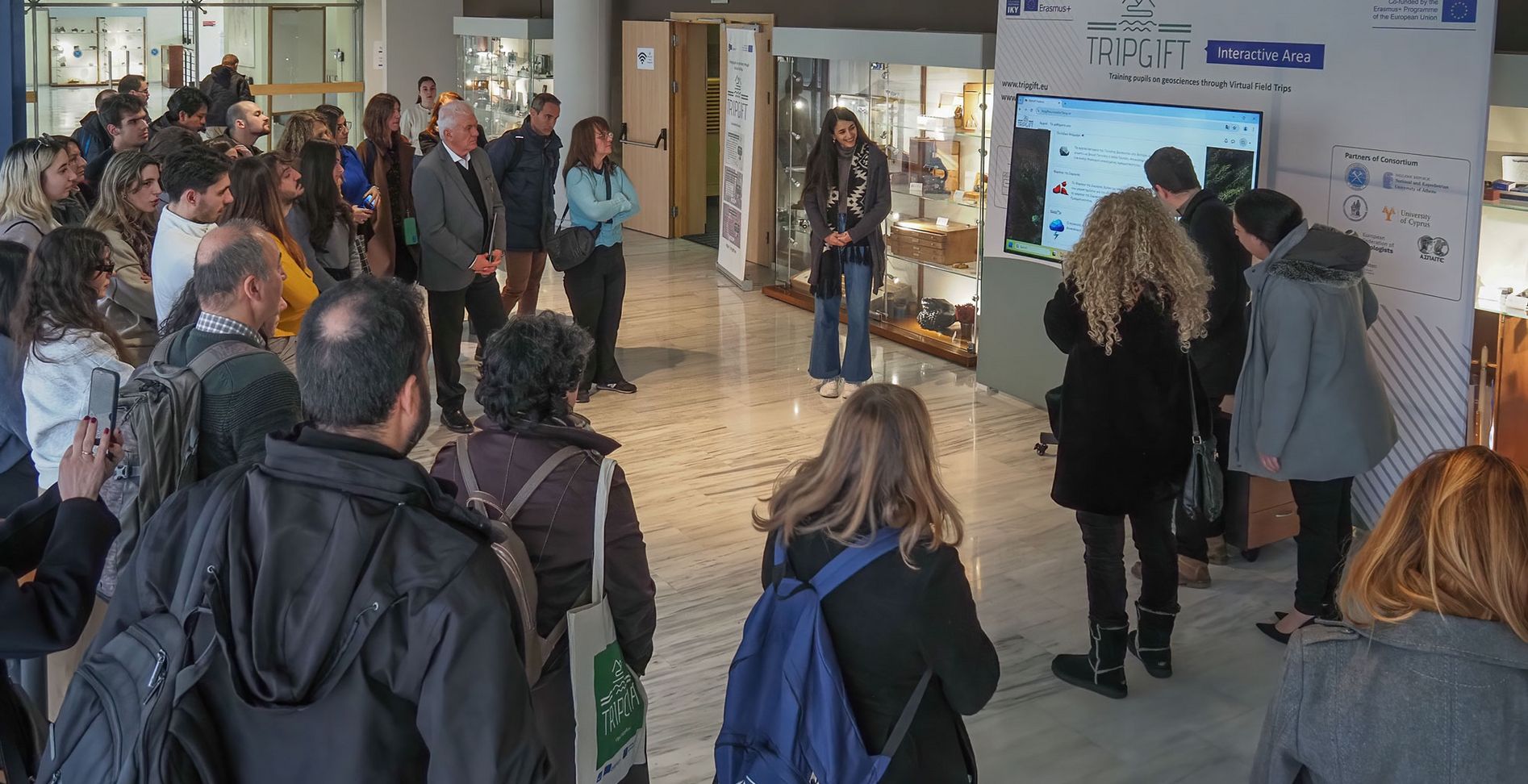
The Hellenic Survey of Geology and Mineral Exploration (HSGME), staying true to its commitment to promoting the Earth sciences and aligning with modern trends in digital transformation, successfully organized on Tuesday, January 11, the hybrid conference (webinar) TripGift.
The TripGift project (“Training Pupils on Geosciences through Virtual Field Trips”) was implemented under the Erasmus+ program by ΕΑGME, in collaboration with the National and Kapodistrian University of Athens (NΤUA), the National Observatory of Athens (NOA), the European Federation of Geologists (EFG), the University of Cyprus, and the School of Pedagogical and Technological Education (ASPETE).
The purpose of the event was to present the project’s results and methodology, highlight the usefulness of new technologies in education, and showcase best practices developed throughout its implementation.
In his opening remarks, ΕΑGME's General Director, Mr. Dionysios Goutis, emphasized the importance of initiatives such as this webinar, which promote the science of geology to younger generations and school students through modern digital tools. A greeting was also delivered by Dr. Konstantinos Laskaridis, Project Coordinator and Director of Mineral Resources and Mining at ΕΑGME.
Additional greetings were offered by Dr. Athanasios Ganas (President of the Geological Society of Greece and Director of Research at the Geodynamic Institute of NOA), MSc Maria Tzima (President of the Association of Greek Geologists), and Dr. Pavlos Tyrologos (External Relations Officer, European Federation of Geologists).
The TripGift Erasmus+ project focuses on educating students in geosciences through virtual field trips and innovative teaching methods that employ digital technologies to create interactive, field-like experiences in the classroom. This approach allows students to explore geological sites and phenomena remotely, enhancing their learning experience.
During the presentations, scientists and young researchers demonstrated how various geological phenomena can be studied and understood through educational digital tools and how these methods can be integrated into school curricula.
The webinar was attended with great enthusiasm by students from the Evangeliki School of Smyrna and the 26th Model School of Athens, who showed strong interest in new digital educational technologies.