

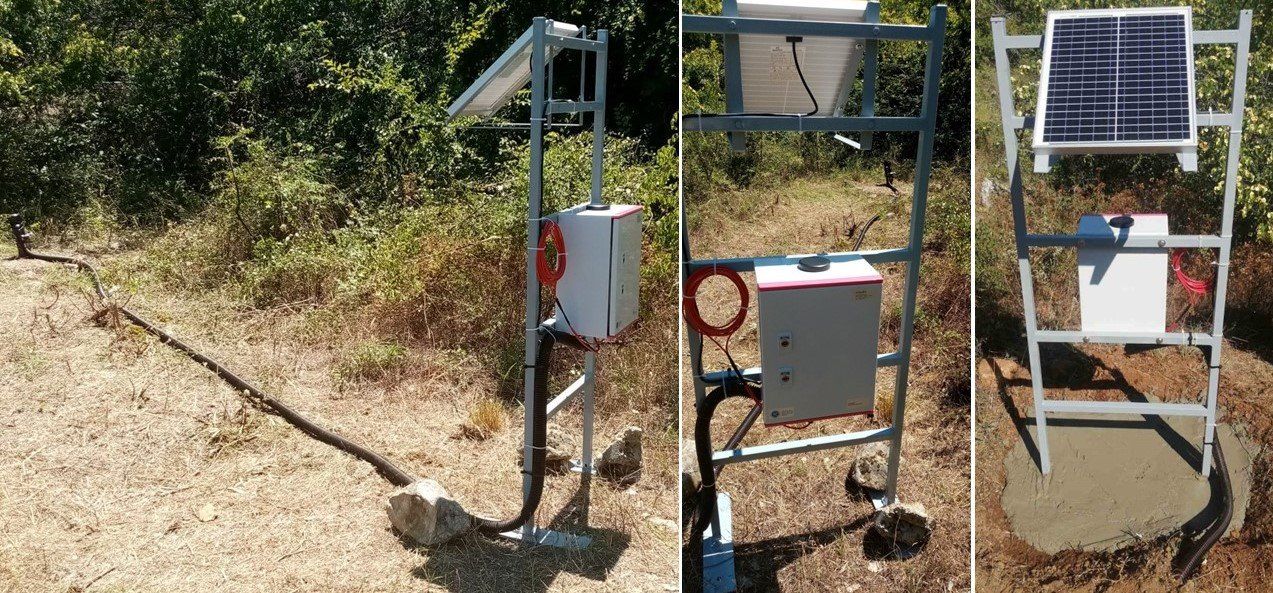
The Hellenic Authority for Geological and Mineral Research (EAGME), within its institutional responsibility for the monitoring of the country’s geothermal fields—through the installation of recording stations—and in response to the concerns of the local community, proceeded with the installation of a new telemetric station at the low-temperature (local interest) geothermal field of Agkistro, Serres, on July 14, 2022. The action was carried out under the Subproject “Actions for the Rational and Sustainable Exploitation of Geothermal Energy – GEOTHERM” (Activity 2: “Long-term Monitoring of Thermal Natural Resources and Geothermal Fields in Greece”).
The installation of the new geothermal telemetric station was undertaken by a team from the Department of Geothermal and Thermal Natural Resources (GEOTHE) of EAGME, consisting of: (a) Dr. Apostolos Arvanitis, Geologist–Geothermal Specialist, Head of GEOTHE; (b) Markos Xenakis, Geologist; (c) Polyanthi Trimi, MSc Mining & Metallurgical Engineer; and (d) Christos Mylonas, Electronics Technician.
The new monitoring station enables continuous recording and real-time telemetry of the temperature and pressure (water level) parameters of the reservoir. It was installed in the old small-diameter exploratory borehole IGME GA-4 (AGK-GA4), 170 m deep and located approximately 93 m southeast of the main Loutra spring. Temperature and pressure sensors were placed at depths of 135 m and 31.3 m respectively to monitor parameter fluctuations. Prior to installation, downhole temperature and water-level measurements were performed (water level recorded at 0.79 m). The selection of 135 m for the temperature sensor was based on the evaluation of historical borehole temperature profiles (5/3/1997, 11/7/2019, and 14/7/2022). The station is powered by a solar (photovoltaic) panel, which charges its internal battery via a charge controller.
The installation of the geothermal telemetric station AGK-GA4, southeast of the Loutra Agkistrou spring, marks the first step of EAGME toward the continuous monitoring of the area’s geothermal system and the extraction of valuable scientific data, with the ultimate goal of safeguarding the sustainability of the thermal spring—a key factor in the economic revival of Agkistro, a village that until a few decades ago was marginalized and in decline.
Agkistro, a village in the Municipality of Sintiki near the Greek–Bulgarian border with around 370 inhabitants, is known for its thermal waters (~40 °C). Until the mid-1990s, the Loutra Agkistrou (Byzantine Bath) was almost unknown and in poor condition. Since then, restoration of the Byzantine bath complex, construction of a modern hotel, seven indoor pools, and a landscaped outdoor area have transformed the site into a tourist attraction, drawing about 100,000 visitors annually. Over 30 new businesses (accommodation, restaurants, entertainment venues, shops) have opened, boosting the local economy and eliminating unemployment. Agkistro is now regarded as a model of regional development based on the sustainable use of thermal waters for wellness and recreation.
During 1996–1997, as part of systematic geothermal research, six exploratory boreholes were drilled by IGME in the area—five small-diameter (GA-1 to GA-5) and one large-diameter (GA-4P)—at depths between 120 m and 312 m, identifying waters up to 48 °C. Test pumping in GA-4P revealed: (a) Thermal waters circulate through faults and ascend from depth to the surface as springs; (b) Local lateral inflow of warm water occurs; (c) Water temperatures may reach ~60 °C in some locations; (d) No distinct geothermal reservoir was identified—the thermal waters likely rise through faults and move horizontally through permeable formations; (e) The absence of an impermeable cap allows mixing of hot and cold waters, causing temperature variations; (f) The system is “open,” with source temperature and flow varying according to rainfall; (g) Two aquifers were found in GA-4 (a shallow one at 45–50 m and a deeper one at 125–140 m) separated by a semi-permeable layer; (h) During test pumping, vertical flow through the semi-permeable layer caused a temperature drop in GA-4P (from 41.3 °C to 37.4 °C) and a rise at the springs (from 42.7 °C to 43.6 °C); (i) The hydrothermal system of the Loutra area exhibits leakages.
These findings indicate that the geothermal system of Loutra Agkistrou, due to the semi-permeable formations and lack of an impermeable cap isolating the hot aquifer, is highly sensitive to external conditions (rainfall, snowfall). This creates a delicate balance between cold and warm water inputs. Disturbances in this balance have led to observed temperature fluctuations at the springs (between 42.5 °C and 37 °C), raising understandable concerns among the local community regarding its long-term sustainability.