
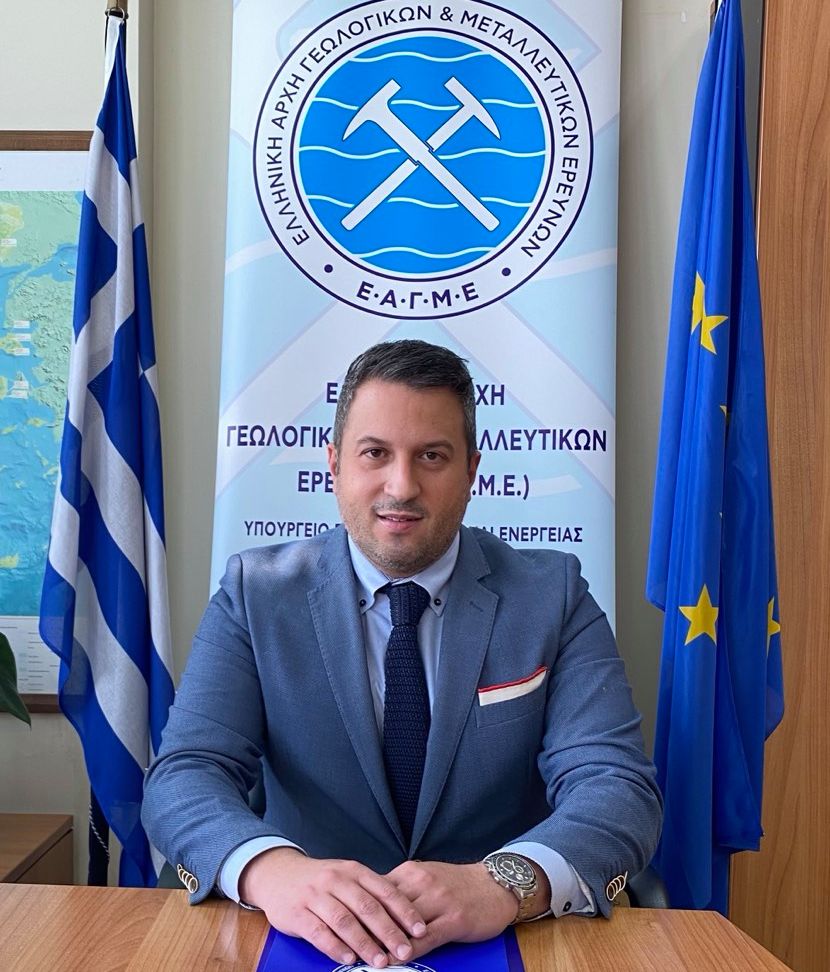
When we took over the management of the Hellenic Survey of Geology and Mineral Exploration (EAGME) two and a half years ago — the successor of the historic IGME — we immediately realized that it was a “sleeping giant” that needed to be awakened.
The official body for Earth Sciences in Greece, having completed a century of service to the country, was in a state of inertia. Not due to a lack of expertise or commitment, but because the vast knowledge and wealth of its work had remained “locked away” for decades. Therefore, it became imperative to promote extroversion — to highlight its social contribution and to disseminate scientific knowledge to society.
We developed an action plan with a dual focus: on one hand, to promote EAGME’s research and scientific work, and on the other, to strengthen its social contribution through scientific documentation and monitoring of Geology and mining issues, as well as its assistance in the sustainable management of the country’s underground wealth.
When we opened the Authority’s storerooms and examined its mineral and rock collections, we realized we possessed a priceless scientific treasure that had to become accessible to the public — especially to young people. This led to the decision to create the first National Geological Museum, an initiative inspired by former General Director of EAGME, Andreas Tsokos. The museum is expected to open soon, offering visitors the opportunity to admire rare exhibits from Greece’s geological heritage through modern, digital means of presentation.
The science of geology, as recently highlighted, plays a key role in developing a framework for the utilization of the country’s geothermal potential, promoted by the Ministry of Environment and Energy. Thus, EAGME’s contribution to this challenge will be decisive in accelerating the exploitation of geothermal fields.
Geothermal energy, without a doubt, can and must become a stable source of clean energy, offering multiple benefits to society, the economy, and the environment. It will help reduce energy costs for households and businesses and can be applied across a wide range of sectors — from electricity production and agriculture to thermal tourism. It will also contribute to achieving national climate goals by reducing greenhouse gas emissions and advancing the transition to climate neutrality by 2050.
The EAGME of tomorrow is an organization at the forefront of the country’s scientific activity, playing a critical role in leveraging Recovery Fund resources and supporting the government’s strategy for transitioning to a low-carbon economy, in line with the roadmap for addressing climate change and environmental challenges under the European Green Deal.
With strength through knowledge, we continue to serve Greece as a national geoscientific data center and as a technical advisor to the state on geological, mineral, mining, geotechnical, hydrogeological, environmental, and geohazard issues. The scientists and staff of EAGME represent its greatest asset and an invaluable contribution to the Greek State. Investing in them and their work is not only a clear commitment but also an obligation — a recognition of their service and contribution to the nation’s development.
Read the full article by Mr. Dionysios Goutis on ot.gr: